






Introduction
Mabel Barltrop (1866–1934, née Andrews) was a British mystic and the founder of an apocalyptic and millenarian religious community called the Panacea Society, based in Bedford, United Kingdom. She had been brought up as a member of the Church of England and she became a follower of the nineteenth-century English prophet Joanna Southcott (1750–1814) as an adult. The Society’s members recognised Barltrop as the eighth in a line of Southcottian prophets, and she adopted the name ‘Octavia’ (from the Latin octavus, ‘eighth’) in her religious activities (for convenience, Barltrop is referred to by her chosen name, Octavia, throughout this article though it was only taken on in 1919). Ultimately, the Society came to regard Octavia as Southcott’s biological and transcendental daughter, as the child of the “woman clothed with the sun” referred to by the book of Revelation (chapter 12), and as a female messiah counterpart to Jesus Christ.
Octavia’s developed theology drew on her Anglican background and the teachings of Southcott, and she took inspiration from the writings of the seventeenth-century mystic Jane Lead (1624–1704) and other writers and prophets. She was also an interpreter of the Bible and Anglican theology, and an adept of the spiritualist practice of automatic writing. At the core of her religious teaching was the idea that Jesus Christ and God the Father had completed the salvation of human souls, and that she as female messiah with God the Mother would complete the salvation of human bodies, achieving overall salvation for her followers. Anticipating the Second Coming of Jesus Christ and the initiation of a worldwide millennium of divine rule through the British Empire, Octavia led her community in worship services modelled after Church of England practice, received daily communications from the divine by automatic writing, directed a campaign to have Joanna Southcott recognised by the bishops of the Church of England, and blessed pieces of linen that were distributed by post to provide healing. When Octavia died in 1934, the members in Bedford initially anticipated her immediate return to life but arranged her burial a week later when she failed to do so.
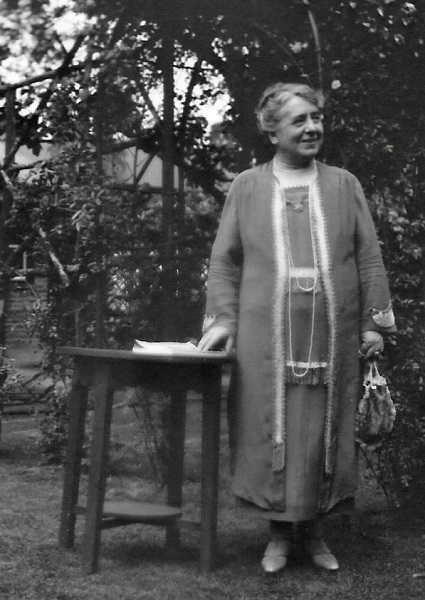
Life
Octavia was born in Peckham to the south of London (now a district of the city) on 11 January 1866 to Katherine Ann Andrews (née Buxton) and Augustus Andrews, a bank clerk. She was the second child after her brother Charles, born in 1859. Her father died when she was nine years old following which she went, with her mother and brother, to live with her aunt, Fanny Waldron, ten miles away in Croydon. Her brother emigrated to South Africa two years later, and they did not see each other again. She was brought up in relatively well-to-do middle-class style including attending a local private girls’ school and, when she was older, teaching in the Sunday School and taking part in local philanthropic and charity work. She was well-read throughout her life and in her twenties participated in an upmarket literary salon through some well-connected cousins in her father’s family.
In 1884 Octavia was engaged to Arthur Barltrop, who was a teacher at a boys’ school for the sons of poor clergymen and was beginning training for ordination. They were married in 1889. Arthur and Mabel had four children between 1890 and 1898. Arthur became unwell from around 1896, and the family moved fairly frequently as Arthur had difficulty finding a permanent position. Mabel recorded that she had her “first experience of a Divine Voice” in 1895 when she “heard distinctly the words ‘Art thou able to drink of the cup that I shall drink of?’” which she later understood to be a prefiguring of her husband’s impending illness (Octavia n/d, 39). The family was living in Bedford—a county town about fifty miles north of London—when Arthur died from a brain tumour in 1906. At the time that Arthur died, Mabel was an inpatient in a local mental hospital. She would become a patient for a second time at another nearby asylum in 1915, at first on a voluntary basis but eventually under compulsion. Jane Shaw notes a diagnosis of melancholia and depression associated with both admissions, and “a strong religious element to whatever ailed her” (Shaw 2011, 20). Mabel suggests in a memoir that her mental health difficulties were linked to her husband’s “most mysterious and perplexing form of illness” (the tumour was only discovered at the post-mortem) which “was a sword hanging over our heads […] a matter of perpetual fear and anxiety” (Octavia n/d, 40).
In 1914 Octavia discovered the writings of Joanna Southcott, an early nineteenth-century English prophet. She seems to have been quickly persuaded by Southcott’s writings and immediately regarded herself as a follower. She shared her convictions with friends and family and gradually became part of a network of women interested in Southcott’s teachings who mainly interacted through letters. As Octavia’s standing grew amongst those she communicated with, she became the centre of the network, and participants began to travel to Bedford to see her. Her friend and follower Rachel Fox recorded that “gradually her home became an open house to all who were catching at the threads which were floating about like gossamer in the early dawn of this mighty revelation” (Fox 1927, 69). In February 1919, one of Octavia’s friends came to the realisation that she (Octavia) was the mystical child of Joanna Southcott returned to the earth, and by March 1920 the Society was established under Octavia’s leadership and messiahship. In time she established a community living in a number of houses around a central garden around her house in the middle of Bedford. The community had sixty-six members living in Bedford at its peak in 1939, nearly 2,000 other recognised members living elsewhere by 1943, and over 100,000 applications for the Society’s healing system over the course of the twentieth century (discussed further under “Theology,” below).
As well as the everyday business of heading up the community, with much of the operational and management work overseen by Emily Goodwin (1858-1943) who was herself able to channel the voice of the female element of the divine, Octavia received daily messages from the divine by automatic writing (published by the Society as The Writings of the Holy Ghost), led the community in religious services modelled on Church of England practices, blessed pieces of linen which were distributed to applicants around the world to provide healing, and directed a campaign to have Joanna Southcott recognised by the bishops of the Church of England.
Octavia died in her sleep on 16 October 1934 at the age of 68. Her followers kept the body for several days in the hope that she might come back to life, and she was buried in Bedford Cemetery after a week. Following her death, Emily Goodwin took over as leader of the Panacea Society. The Society went into decline after World War Two, before formally ending its religious activities in 2012. While there are still a few active followers of Joanna Southcott, there are no longer any known followers of Octavia.
Theology
Octavia had a developed, albeit informal, training in theology. While she was growing up, she attended the local ’low’ Anglican Church with her aunt Fanny, though her mother went to a different church nearby with a more Anglo-Catholic orientation which Octavia often attended for evensong. She said she had “a curious combination of love of High Church ceremonial and a belief in Low Church principles” (Octavia n/d, 19). In a brief memoir she wrote around 1924, she recalled playing as a small child with even younger children: “I taught them a great many prayers […] That they must know the Bible well was a great point, and I used to read principally the Book of Esther to them for some reason” (Octavia n/d, 15). After her engagement, she recorded taking a close interest in Arthur’s theological training and read “everything her fiancé read” so that she “knew the history and texts of orthodox Christianity better than most women and many men” (Shaw 2011, 59). She continued to read and study theology for the rest of her life.
Octavia discovered the writings of Joanna Southcott in 1914. Southcott was born into a working family in the southwest of England in 1750 and worked as a domestic servant for much of her life. In the 1790s she began to have visions, and she developed a local reputation as a prophet before her first book, The Strange Effects of Faith (1801), attracted a wide readership; she moved to London and began to attract a significant following. The two key aspects of Southcott’s teaching for Octavia—and thus they formed key tenets of the theology of the Panacea Society—were the expectation that the Second Coming was due soon, and that a woman would play the primary role in bringing it about.
Southcott was renowned, amongst other things, for her declaration in 1814, aged sixty-four, that she was pregnant with the messiah through the Holy Spirit. She died in December that year without giving birth to a physical child, some of her followers believing the child was born but taken immediately to heaven. In February 1919, Octavia was recognised as the mystical child of Southcott returned to earth. An undated draft letter in the Panacea Society archives records: “She lived an ordinary life, but one full of the needed and varied experiences which enabled her to deal with every side of human life. In 1914, exactly 100 years after the soul-birth, she was introduced to Joanna’s Writings and in a moment realised and accepted them as the Message the world is waiting for” (‘Dear Friend’ n/d).
The core aspect of Octavia’s theology was her understanding of the apocalyptic role of a woman. This was developed out of an interpretation of Genesis 3, which recounts the story of the first humans created by God. Adam and Eve, who had been placed in the garden of Eden, had been told they could eat any of the garden’s fruit aside from the fruit of one particular tree, which they must not even touch (Genesis 3:3). Eve was tempted by a serpent to eat the forbidden fruit and gave some to Adam, who also ate it (Genesis 3:4–6). As a result, God punished Eve and her female descendants with suffering in childbirth and being ruled over by her husband; Adam and his male descendants were punished with labour in cultivating fields for food (Genesis 3:16–19); and both were expelled from the garden (Genesis 3:23–24). (The serpent’s punishment was to move about on its belly and to eat dust [Genesis 3:14].) At the core of Octavia’s beliefs, and derived from Southcottian theology, was the idea that because Eve as the cosmological female was regarded as responsible for the fall of humanity into sin by disobeying God in the garden, a divinely ordained female would be required to repair that disobedience and restore humanity to its original perfection. Octavia and her followers believed that Octavia was that divinely ordained woman and that she would complete the apocalyptic cycle.
The garden of Eden, and its link to the book of Revelation, seems to have been a lively point of interest in Octavia’s family before the death of her husband and the establishment of the Panacea Society—at least as she recorded it in the memoir written for her followers around 1924. She recalled there that her husband “always insisted on the great connection between Genesis and Revelation” and noted a sermon “in which he said something to the effect that we have never found the right gate out of Revelation which will take us back to Genesis before the Fall” (Octavia n/d, 33). She said the Second Coming was “very real” to her husband: “he always preached a careful Advent Course […] dealing with the need to prepare for the actual promises of the Second Coming” (Octavia n/d, 34). Talking about the precocious theologising of her children when they were small, she commented in her memoir that “[t]he story of Adam and Eve was always most fascinating to all of them and the questions asked were many, the great point being how to get back into that delightsome garden” (Octavia n/d, 35). She believed that in the Panacea Society, “we know that we have got back again to the Church in Eden, to its covenant and to its symbol, as we have found the gate which led us there” (Octavia n/d, 33).
Octavia identifies an important change in her thinking about her husband in 1923 following a “revelation” (the details of which are unclear). Nevertheless, before that time she understood her position as unique and distinct and thus not connected to her husband: “I believed that in my mysterious and wonderful work, I was required to forget him, and […] I endeavoured so to do” (Octavia n/d, 41). After the revelation, she realised that the coordination of a cosmological male and female was necessary to the completion of her apocalyptic mission, and that the participation of all parts of a “God-Family […] comprising the Father, the Mother, the Son and the Daughter” was essential. In some sense, then, she came to see her husband as having a divine role, and their marriage as representing a transcendental whole:
[M]y husband had his part to play in the work which will bring “release to the suffering,” and that, as the Man is not without the Woman, nor the Woman without the Man, in making up what has, so far, been called “the Lord,” with only a masculine meaning, so also the LAW of God is DUAL, and all will be done dually, for, “male and female created He him.” (Octavia n/d, 42, uppercasing in original)
She received at least one communication from her husband after he had passed away. Whilst Octavia was in the mental asylum for the second time (in 1916), another patient claimed to have received a message from Arthur—it was the date of the couple’s wedding anniversary and the recipient gave it to Octavia at the same time of day that the marriage had taken place. The message was in the form of a poem; it offered reassurance and support, and promised his love and protection from the divine realm (Besma 1919, 62). It ended by encouraging Octavia in her work and asserting the female aspect of the godhead:
“There’s no death,” take thou this message,
Forward! with thy work sublime!
God shall lead thee, Love shall shield thee,
“Neath Her canopy Divine.”
(Octavia n/d, 43, emphasis in original)
The version of the poem discussed here (dating from around 1924) is emphatic in the gendered language of the final line, which is printed in the original with an italic “Her”; a manuscript letter dated 1 June 1916 in the Panacea Charitable Trust archive also includes “her” in the final line (‘June 1, 1916’).
While she had reflected on the value of religious healing at various points in her life, a formative moment of Octavia’s mission occurred in February 1921 when she was inspired to not take some medication, but to drink only the water she would have used to swallow the tablet. She prayed that the water would be “made effectual in the place of medicine” and felt called to “overcome sickness by relying on the Lord alone” (Fox 1927, 162–63). Over time, she developed the idea that the taking of blessed water would physically introduce a divine element into anybody that consumed it. As such, there was no intellectual process of assent to take place, no psychological conversion as such; as long as a follower consumed the water as prescribed by the Society, their body would begin to throw off mortality and thus sickness. The Society advertised the healing widely in newspapers and magazines from 1924 and into the 1980s; those writing in were sent a piece of linen (which had been breathed on by Octavia to impart the healing power). The linen was to be steeped in water and was sent with instructions on how and when to consume it or apply it to the body. The Society received and responded to more than 100,000 applications from over 100 different countries or territories between 1924 and the Society’s closure in 2012; three-quarters of the applications were received during the period before 1939. As it proliferated in popularity, the healing came to be seen as the process by which Octavia would extend physical salvation to the world in her role as messiah.
Sources
Octavia wrote an undated short autobiography for her followers around 1924, Octavia’s Early Years, and the story and activities of the Panacea Society are exhaustively recorded in a series of books written by one of Octavia’s most loyal followers, Rachel Fox: The Finding of Shiloh (1921), The Sufferings and Acts of Shiloh-Jerusalem (1927), How We Built Jerusalem in England’s Green and Pleasant Land: Part I (1931), and How We Built Jerusalem in England’s Green and Pleasant Land: Part II (1934). The Society also published a journal series, The Panacea, without dates, which includes a diverse mix of articles based on the Society’s theology, beliefs, and interests—many of these were written pseudonymously by Octavia. Brushes with the Bishops, written by Octavia but published anonymously, gives an account of her experience of mental illness and her time in the asylum within the framework of her religious vision and her religious campaigning. The Writings of the Holy Ghost, a collection of divine messages received by Octavia between 1919 and 1934 were published by the Society in short pamphlets and eventually compiled into a set of sixteen volumes.
The Society believed their work and activities were the centre of a process that would see the return of Jesus Christ and the arrival of the divine millennium. As such, they carefully collected and preserved documents and records which are today catalogued and preserved by the Panacea Charitable Trust at 14 Albany Road, Bedford. These are available for research purposes by arrangement with the trustees of the Trust, and they have provided the basis for recent historiographical work on the Society. In particular, the life of Octavia, her activities as leader of the Panacea, and the wider history of the Society following Octavia’s death in 1934 are recorded in Jane Shaw’s (2011) Octavia: Daughter of God, which used the Trust’s archives and is the only synoptic historical account of the Panacea Society. Shaw also contributed an entry on Octavia to the Oxford Dictionary of National Biography (2012) and has published other accounts of aspects of the Society’s history (2017, 2018a, 2018b).
Using the materials in the archives, Alastair Lockhart (the writer of this article and an editor of CDAMM) has published research on the Society and its healing ministry in particular. These include a monograph on the healing (2019) and articles and chapters on various aspects of the Society’s beliefs and history (2013, 2015, 2017, 2020, 2026). See also Lockhart’s (2021) article on the Panacea Society in the Critical Dictionary of Apocalyptic and Millenarian Movements, and his article with Ryan Williams and Fraser Watts (Williams, Watts, and Lockhart 2022).
Bibliography
Besma [Octavia/Mabel Barltrop]. 1919. Brushes with the Bishops: A Blue Book. London: Cecil Palmer and Hayward.
“Dear Friend.” n/d. Draft letter “from C.S.S. c/o J. Carpenter-Smith Esq.” Panacea Society Archives, Bedford: F.1.3.21.
“June 1, 1916.” Correspondence Mabel Barltrop to Kate Firth Nov 1915–Oct 1916. Panacea Society Archives, Bedford: F.4.1.1.
Fox, Rachel, J. n/d [1921]. The Finding of Shiloh or the Mystery of God “Finished”. London: Cecil Palmer.
Fox, Rachel, J. 1927. The Sufferings and Acts of Shiloh-Jerusalem (A Sequel to “The Finding of Shiloh”). London: Cecil Palmer.
Fox, Rachel, J. 1931. How We Built Jerusalem in England’s Green and Pleasant Land: Part I. London: Cecil Palmer.
Fox, Rachel, J. n/d [1934]. How We Built Jerusalem in England’s Green and Pleasant Land: Part II. Bedford: Garden Press.
Lockhart, Alastair. 2013. “Heterodox Healing and Alternative Religion in the 20th Century: An English Spiritual Healing Practice in Finland.” In Suomen kirkkohistoriallisen seuran vuosikirja 2013 , edited by Jaakko Olavi Antila & Milla Bergström, 74–97. Helsinki: Suomen Kirkkohistoriallinen Seura/Societas Historiae Ecclesiasticae Fennica.
Lockhart, Alastair. 2015. “Religious and Spiritual Mobility in Britain: The Panacea Society and Other Movements in the Twentieth Century.” Contemporary British History 29 (2): 155–78.
Lockhart, Alastair. 2017. “A Southcottian Healing Panacea, 1924–2012.” In The History of a Modern Millennial Movement: The Southcottians, edited by Jane Shaw and Philip Lockley, 186–202. London: I.B. Tauris.
Lockhart, Alastair. 2019. Personal Religion and Spiritual Healing: The Panacea Society in the Twentieth Century. New York: State University of New York Press.
Lockhart, Alastair. 2020. “Demise and Persistence: Religion after the Loss of ‘Direct Divine Control’ in the Panacea Society.” In The Demise of Religion: How Religions End, Die, or Dissipate, edited by Michael Stausberg, Stuart A. Wright, and Carole M. Cusack, 83–96. London: Bloomsbury Academic.
Lockhart, Alastair. 2021. “Panacea Society.” In Critical Dictionary of Apocalyptic and Millenarian Movements, edited by James Crossley and Alastair Lockhart. Retrieved from www.cdamm.org/articles/panacea-society.
Lockhart, Alastair. 2026. “Reclaiming Eschatology: Healing and a Female Messiah.” In Health and Healing in Minority Religions, edited by Sarah Harvey and Eileen Barker, 57-75. Abingdon: Routledge.
Octavia [Mabel Barltrop]. n/d. Octavia’s Early Years. Plymouth: Privately published.
Octavia [Mabel Barltrop]. [1919–1934.] Writings of the Holy Ghost. 16 vols. [Bedford: Panacea Society.]
Shaw, Jane. 2011. Octavia, Daughter of God: The Story of a Female Messiah and her Followers. London: Jonathan Cape.
Shaw, Jane. 2012. “Barltrop, Mabel [name in religion Octavia].” In Oxford Dictionary of National Biography. 4 October. Retrieved from https://doi.org/10.1093/ref:odnb/93402
Shaw, Jane. 2017. “Southcottians in the Early Twentieth Century: The Panacea Society.” In The History of a Modern Millennial Movement: The Southcottians, edited by Jane Shaw and Philip Lockley, 164–85. London: I.B. Tauris.
Shaw, Jane. 2018a. “Englishness, Empire and Nostalgia: A Heterodox Religious Community’s Appeal in the Inter-War Years.” Studies in Church History: The Church and Empire 62: 374–92.
Shaw, Jane. 2018b. “Joanna Southcott and Mabel Barltrop: Interpreting Genesis and Revelation.” In The Bible and Feminism: Remapping the Field, edited by Yvonne Sherwood, 45–60. Oxford: Oxford University Press.
Southcott, Joanna. 1801. The Strange Effects of Faith: with Remarkable Prophecies - Made in 1792, &c. - of Things Which Are to Come: Also Some Account of my Live. Exeter. [No publisher details.]
Williams, Ryan J., Fraser Watts, and Alastair Lockhart. 2022. “Health Help-Seeking Behaviour in Spiritual Healing Practice: Records from the Panacea Society’s Healing Department, 1924–1997.” Journal of Religion and Health 61: 2417–32.